Structured Flexibility in Assessment: Students’ Perceptions of the Impact of Different Elements of Choice on Their Decision Making, Engagement, and Learning Experiences
DOI:
https://doi.org/10.20343/teachlearninqu.13.61Keywords:
assessment, flexibility and choice, student engagement and learning, grand challenges, mixed methodsAbstract
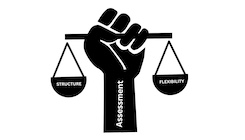
Research on the learning- and engagement-related impacts of choice in assessment is growing, though it often focuses on a single kind of choice with insufficient attention to the learning priorities and motivations behind students’ decisions. The assessment design explored here offered flexibility to students by providing multiple kinds of choice while maintaining the critical structure of a single type of assignment, which was necessary to preserve learning outcomes and not overwhelm students. This study investigated the impact of choice not only on students’ perceptions of their learning and engagement but also on their decision making process in order to better understand their motivations and the influences of learning priorities and individual circumstances. Guided by a mixed methods approach involving a survey followed by interviews, we found that offering choice in assessment increased students’ perceived autonomy and control, ability to balance other demands, quality of work, and enjoyment and interest in the work, while decreasing their stress levels. We also found that offering multiple elements of choice in a single assessment supported students’ abilities to make decisions based on their complex and diverse learning priorities, motivations, and individual circumstances. This study, as well as research on flexible assessment more broadly, respond to the International Society for the Scholarship of Teaching and Learning’s grand challenges, which include a call for more investigation into student engagement in learning and the complex processes of learning.
References
Behari-Leak, Kasturi. 2020. “Toward a Borderless, Decolonized, Socially Just, and Inclusive Scholarship of Teaching and Learning.” Teaching & Learning Inquiry 8 (1): 4–23. https://doi.org/10.20343/teachlearninqu.8.1.2. DOI: https://doi.org/10.20343/teachlearninqu.8.1.2
Braun, Virginia, and Victoria Clarke. 2006. “Using Thematic Analysis in Psychology.” Qualitative Research in Psychology 3 (2): 77–101. DOI: https://doi.org/10.1191/1478088706qp063oa
Braun, Virginia, and Victoria Clarke. 2022. Thematic Analysis: A Practical Guide. London: SAGE Publications Ltd. DOI: https://doi.org/10.53841/bpsqmip.2022.1.33.46
CAST. 2018. Universal Design for Learning Guidelines. Accessed May 28, 2024. https://udlguidelines.cast.org/.
Cook, Averil. 2001. “Assessing the Use of Flexible Assessment.” Assessment & Evaluation in Higher Education 26 (6): 539–49. https://doi.org/10.1080/02602930120093878. DOI: https://doi.org/10.1080/02602930120093878
Coulter, Sawyer E., Paige Coyne, and David M. Matthews. 2024. “The Choice Is Theirs: Students Achieve Positive Outcomes When Offered Flexibility in Course Assessment Options.” The Canadian Journal for the Scholarship of Teaching and Learning 15 (1). https://doi.org/10.5206/cjsotlrcacea.2024.1.14923. DOI: https://doi.org/10.5206/cjsotlrcacea.2024.1.14923
Coyne, Paige, and Sarah J. Woodruff. 2022. “Giving Students Choice: Does the Use of a Flexible Assessment Weighting Scheme Result in Better Student Grades?” International Journal of Teaching and Learning in Higher Education 33 (3): 398–406. https://www.isetl.org/ijtlhe/pdf/IJTLHE4117.pdf.
Crookes, Annie. 2007. “The Effects of Topic Choice on Performance Outcomes: An Analysis of Student Selected Third Year Essays.” Psychology Learning and Teaching 6 (2): 85–90. https://doi.org/10.2304/plat.2007.6.2.85. DOI: https://doi.org/10.2304/plat.2007.6.2.85
El Galad, Asil, Dean Harvey Betts, and Nicole Campbell. 2024. “Flexible Learning Dimensions in Higher Education: Aligning Students’ and Educators’ Perspectives for More Inclusive Practices.” Frontiers in Education 9. https://doi.org/10.3389/feduc.2024.1347432. DOI: https://doi.org/10.3389/feduc.2024.1347432
Francis, Robert A. 2008. “An Investigation into the Receptivity of Undergraduate Students to Assessment Empowerment.” Assessment & Evaluation in Higher Education 33 (5): 547–57. https://doi.org/10.1080/02602930701698991. DOI: https://doi.org/10.1080/02602930701698991
Hanewicz, Cheryl, Angela Platt, and Anne Arendt. 2017. “Creating a Learner-Centered Teaching Environment Using Student Choice in Assessments.” Distance Education 38 (3): 273–87. https://doi.org/10.1080/01587919.2017.1369349. DOI: https://doi.org/10.1080/01587919.2017.1369349
Hills, Melissa, and Kim Peacock. 2022. “Replacing Power with Flexible Structure: Implementing Flexible Deadlines to Improve Student Learning Experiences.” Teaching & Learning Inquiry 10. https://doi.org/10.20343/teachlearninqu.10.26. DOI: https://doi.org/10.20343/teachlearninqu.10.26
Huyer, Norbert G. C., Jeroen Dikken, Ellen Sjoer, R. I. Hutter, Anne Venema, and Peter G. Renden. 2024. “Insights in Flexible Assessment from Students’ and Teachers’ Perspectives: A Focus Group Study.” Higher Education Studies 14 (3). https://doi.org/10.5539/hes.v14n3p73. DOI: https://doi.org/10.5539/hes.v14n3p73
Irwin, Brian, and Stuart Hepplestone. 2012. “Examining Increased Flexibility in Assessment Formats.” Assessment & Evaluation in Higher Education 37 (7): 773–85. http://dx.doi.org/10.1080/02602938.2011.573842. DOI: https://doi.org/10.1080/02602938.2011.573842
Jopp, Ryan, and Jay Cohen. 2020. “Choose Your Own Assessment—Assessment Choice for Students in Online Higher Education.” Teaching in Higher Education: Critical Perspectives 27 (6): 738–55. https://doi.org/10.1080/13562517.2020.1742680. DOI: https://doi.org/10.1080/13562517.2020.1742680
Kessels, Giel, Kate Xu, Kim Dirkx, and Rob Martens. 2024. “Flexible Assessments as a Tool to Improve Student Motivation: An Explorative Study on Student Motivation for Flexible Assessments.” Frontiers in Education 9. https://doi.org/10.3389/feduc.2024.1290977. DOI: https://doi.org/10.3389/feduc.2024.1290977
Kumar, Kari L., and Maureen Wideman. 2014. “Accessible by Design: Applying UDL Principles in a First Year Undergraduate Course.” Canadian Journal of Higher Education 44 (1): 125–47. https://files.eric.ed.gov/fulltext/EJ1028772.pdf. DOI: https://doi.org/10.47678/cjhe.v44i1.183704
McKendrick-Calder, Lisa, and Julia Choate. 2023. “Educators’ Lived Experiences of Encountering and Supporting the Mental Wellness of University Students.” Higher Education Research & Development 43 (1): 180–95. https://doi.org/10.1080/07294360.2023.2218810. DOI: https://doi.org/10.1080/07294360.2023.2218810
McKendrick-Calder, Lisa, Christine Shumka, Tanya Heuver, Cheryl Pollard, Kylie Morey, Thomas Chase, and Shivani Solanki. 2024. “Navigating Nursing Student Anxiety: A Conceptual Model.” The Canadian Journal for the Scholarship of Teaching and Learning 15 (1). https://doi.org/10.5206/cjsotlrcacea.2024.1.14705. DOI: https://doi.org/10.5206/cjsotlrcacea.2024.1.14705
Nickels, Kevin, and Mahbub Uddin. 2003. “The Impact on Student Learning of Resubmission of Work and Flexible Deadlines.” Proceedings of the 2003 ASEE Gulf-Southwest Annual Conference, Arlington, Texas. http://www.cs.trinity.edu/~knickels/pubs/NicUdd-aseegsw03.pdf.
O’Neill, Geraldine. 2017. “It’s Not Fair! Students and Staff Views on the Equity of the Procedures and Outcomes of Students’ Choice of Assessment Methods.” Irish Educational Studies 36 (2): 221–36. https://doi.org/10.1080/03323315.2017.1324805. DOI: https://doi.org/10.1080/03323315.2017.1324805
O’Neill, Geraldine, and Tim McMahon. 2005. “Student-Centred Learning: What Does It Mean for Students and Lecturers?” In Emerging Issues in the Practice of University Learning and Teaching, edited by Geraldine O’Neill, Sarah Moore, and Barry McMullin, 27–36. Dublin: All Ireland Society for Higher Education. https://www.aishe.org/wp-content/uploads/2022/09/oneill2005emerging.pdf.
Pacharn, Parunchana, Darlene Bay, and Sandra Felton. 2013. “The Impact of a Flexible Assessment System on Students’ Motivation, Performance and Attitude.” Accounting Education 22 (2): 147–67. https://doi.org/10.1080/09639284.2013.765292. DOI: https://doi.org/10.1080/09639284.2013.765292
Pattal, Erika A., Harris Cooper, and Susan R. Wynn. 2010. “The Effectiveness and Relative Importance of Choice in the Classroom.” Journal of Educational Psychology 102 (4): 896–915. https://doi.org/10.1037/a0019545. DOI: https://doi.org/10.1037/a0019545
Popping, Roel. 2015. “Analyzing Open-ended Questions by Means of Text Analysis Procedures.” Bulletin of Sociological Methodology 128 (1). https://doi.org/10.1177/0759106315597389. DOI: https://doi.org/10.1177/0759106315597389
Pretorius, Lynette, Greg P. van Mourik, and Catherine Barratt. 2017. “Student Choice and Higher-Order Thinking: Using a Novel Flexible Assessment Regime Combined with Critical Thinking Activities to Encourage the Development of Higher Order Thinking.” International Journal of Teaching and Learning in Higher Education 29 (2): 389–401. https://www.isetl.org/ijtlhe/pdf/IJTLHE2631.pdf.
Scharff, Lauren, Holly Capocchiano, Nancy Chick, Michelle Eady, Jen Friberg, Diana Gregory, Kara Loy, and Trent Maurer. 2023. “Grand Challenges for SoTL.” International Society for the Scholarship of Teaching and Learning, November 2023. https://issotl.com/grand-challenges-for-sotl/.
Schroeder, Meadow, Erica Macarenko, and Karly Warren. 2019. “Introducing a Late Bank in Online Graduate Courses: The Response of Students.” The Canadian Journal for the Scholarship of Teaching and Learning 10 (2). https://doi.org/10.5206/cjsotl-rcacea.2019.2.8200. DOI: https://doi.org/10.5206/cjsotl-rcacea.2019.2.8200
Singer-Freeman, Karen, and Christine Robinson. 2020. “Grand Challenges for Assessment in Higher Education.” Research and Practice in Assessment 15 (2): 2020.
Spinney, Jamie E. L., and Suzanne E. Kerr. 2023. “Students’ Perceptions of Choice-based Assessment: A Case Study.” Journal of the Scholarship of Teaching and Learning 23 (1): 46–58. https://doi.org/10.14434/josotl.v23i1.31471. DOI: https://doi.org/10.14434/josotl.v23i1.31471
Wanner, Thomas, and Edward Palmer. 2015. “Personalising Learning: Exploring Student and Teacher Perceptions about Flexible Learning and Assessment in a Flipped University Course.” Computers & Education 88: 354–69. https://doi.org/10.1016/j.compedu.2015.07.008. DOI: https://doi.org/10.1016/j.compedu.2015.07.008
Weimer, Maryellen. 2002. Learner-Centered Teaching: Five Key Changes to Practice. San Francisco: Jossey-Bass.
Withington, Keri, and Heather L. Schroeder. 2017. “Rolling with the Semester: An Assignment Deadline System for Improving Student Outcomes and Regaining Control of the Workflow.” Journal of Student Success and Retention 4 (1): 1–31. https://www.jossr.org/wp-content/uploads/2017/10/Rolling-with-the-semester-Final.pdf.
Downloads
Published
Issue
Section
License
Copyright (c) 2025 Sarah Copland, Melissa Hills, Lisa McKendrick-Calder

This work is licensed under a Creative Commons Attribution-NonCommercial 4.0 International License.