
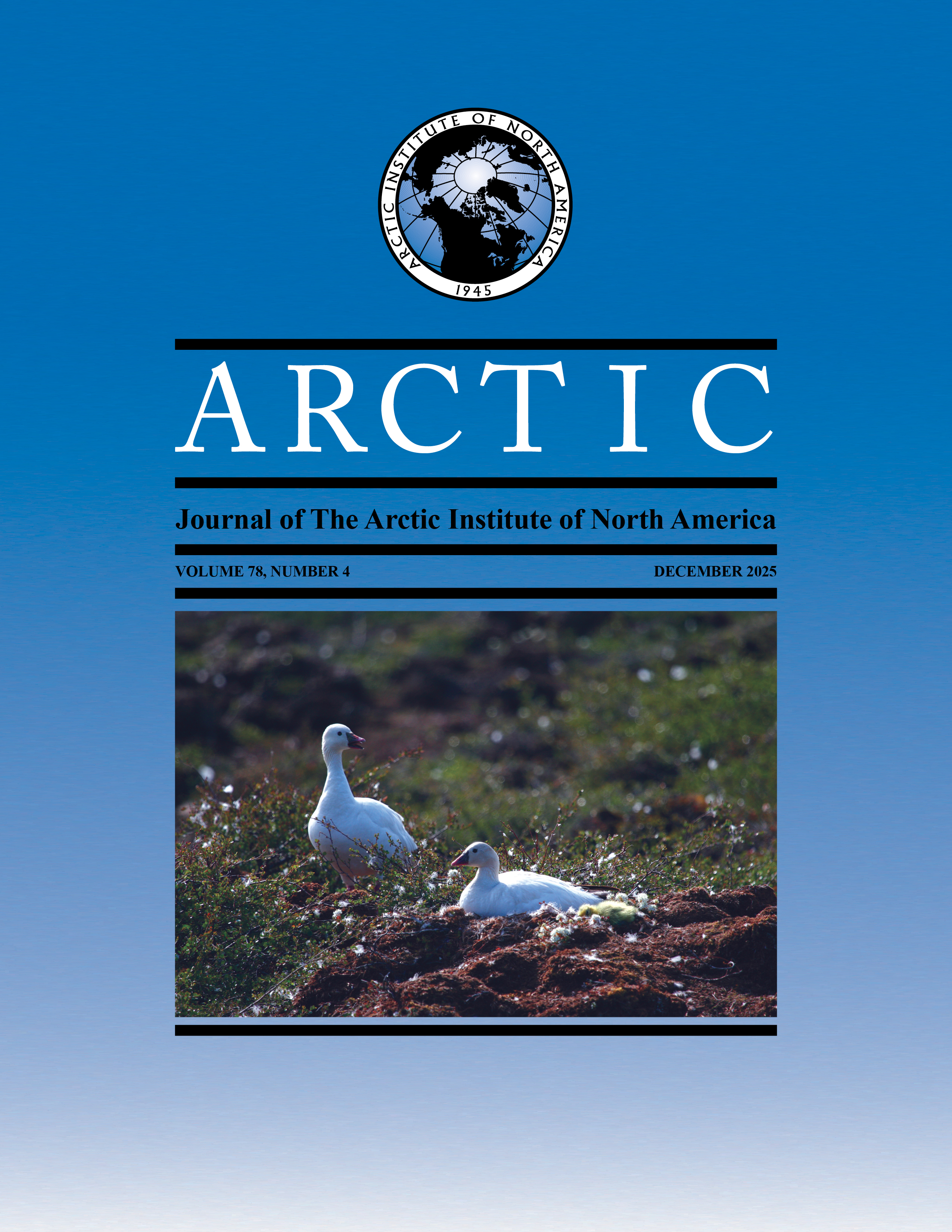
Historic Data on Microarthropod Communities in Nests of Colonial-nesting Arctic Geese at Karrak Lake, Nunavut, Canada
DOI:
https://doi.org/10.14430/arctic83965Keywords:
mites; springtails; fleas; flies; beetles; spidersAbstract
Global environmental change is altering the soils and ecosystems of polar regions, leading to significant consequences for microarthropods. Here, we report the invertebrate fauna from nests of Arctic – nesting light geese, and describe the invertebrate communities represented by these nests. The data are the first of their kind for Ross’s Geese (Anser rossii) and Lesser Snow Geese (A. caerulescens; hereafter, Snow Geese) and were collected in 1994 from 38 nests, at Karrak Lake, Nunavut. The number of individual invertebrates ranged widely in nests of both goose species, and there were no effects of habitat type on number of invertebrates found in the nests. The most common groups of invertebrates found, with 100% percentage occurrence in nests, were mites (Acari) and springtails (Collembola). Diptera (flies) were found in 94 – 95% of nests of both goose species, but no taxonomic level within Diptera was found in more than 50% of the nests. Among these groups, the number of individuals was highly variable among nests, with all three, on average, more numerous among Snow Goose nests. Acari 1 and Acari 2a (orb) were found in 89% of nests of both goose species, and Onychiurid 1 was found in 85% and 72% of Ross’s and Snow Goose nests, respectively. The Siphonapteran larva of Ceratophyllus vagabundus vagabundus were conspicuously more common in Snow Goose nests (78%) than Ross’s Goose nests (35%), with adults found in 44% and 25% of the goose nests, respectively. Other percent occurrences of operational taxonomic units generally were similar between the goose species. The number of individual invertebrates was independent of nest size, regardless of goose species. Our data are an important snapshot of past invertebrate communities and provide a baseline for future studies of microarthropods in the high Arctic.
Downloads
Published
Issue
Section
License
Copyright (c) 2018 ARCTIC

This work is licensed under a Creative Commons Attribution 4.0 International License.