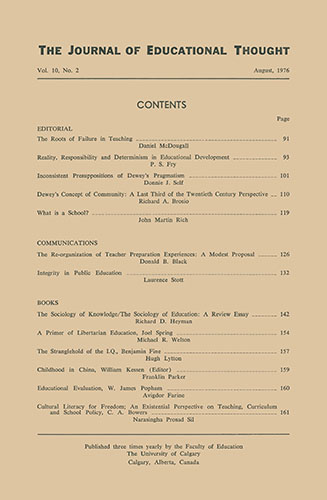
Dewey's Concept Of Community: A Last Third Of The Twentieth Century Perspective
DOI :
https://doi.org/10.55016/ojs/jet.v10i2.43650Résumé
John Dewey belongs to a tradition in the west whose members have attempted to explain how the breakdown of community has occurred. Although Dewey is not a romantic nor a conservative, he acknowledges his debt to their nineteenth century analyses. Dewey argued that the school and the greater society are inextricably one; therefore, the kind of school he favored was dependent upon the building of a democratic community. Dewey's analysis of the disintegrative power of bourgeois liberalism and its inability to replace the synthesis of medieval civilization goes a long way toward explaining the educational, social, political and moral crises which afflict much of the modern industrial west, and especially America.
Téléchargements
Téléchargements
Publié
Numéro
Rubrique
Licence
The Journal of Educational Thought retains first publication rights for all articles. The Journal grants reproduction rights for noncommercial educational purposes with the provision that full acknowledgement of the work’s source be noted on each copy. The Journal will redirect to the appropriate authors any inquiries for further commercial publication of individual articles. All authors wishing to publish in JET will be asked to fill in and sign a Consent to Publish and Transfer of Copyright agreement.
Authors must affirm that any submission to JET has not been and will not be published or submitted elsewhere while under considration by JET.